Orland Park Epoxy Flooring handles concrete floor repair in Orland Park, IL, serving surrounding cities including Palos Heights, Mokena, Worth, Palos Hills and Crestwood. After 20+ years of preparing slabs for coatings, we have repaired cracks, spalls and scaled concrete on garage, basement and commercial floors, and we have also learned to say plainly when a slab is past repair.
Every repair job starts with a map. We walk the floor, mark each crack, spall, pitted area and trip edge, and note which ones are still moving. That map becomes part of the written scope, so you can see exactly what will be repaired, with what material, and what the repair will and will not fix.
Most of our repairs are done as part of a coating job, where the repaired areas disappear under the finished floor. We also repair floors that will stay bare, and in that case we explain up front that patches will remain visible on uncoated concrete.
Cracks and Joints
Hairline and Shrinkage Cracks
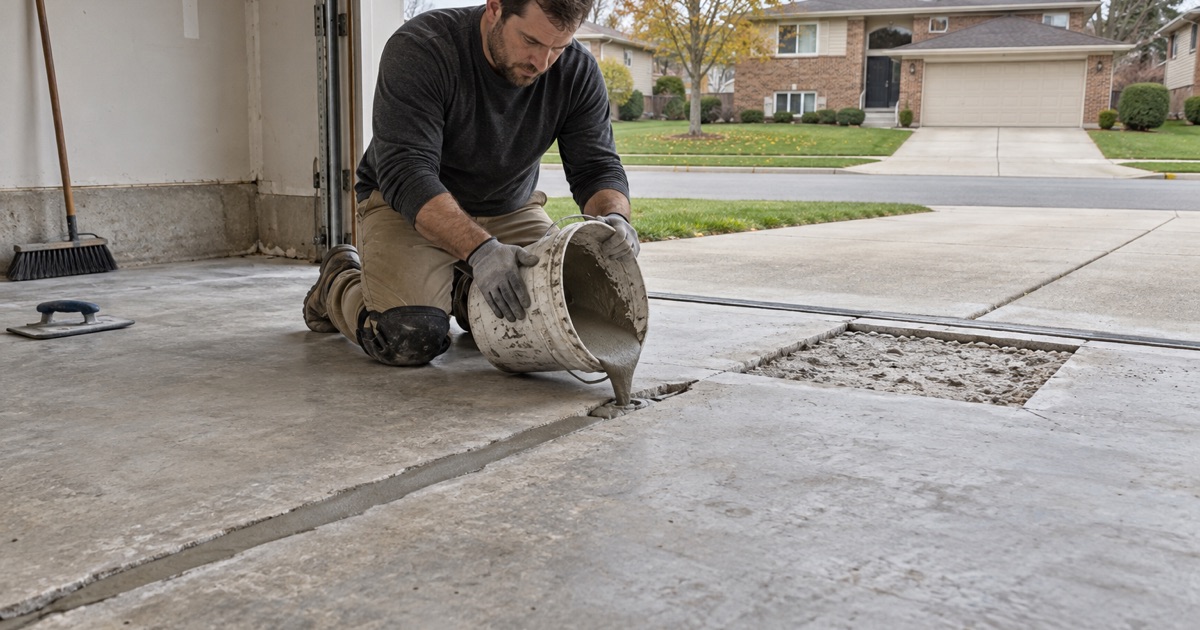
Almost every concrete slab develops shrinkage cracks as it cures and dries, and most of them stop moving once the slab stabilizes. We clean them out, fill them with a rigid epoxy or polyurea repair material and grind the repair flush with the floor. Under a coating, a properly filled shrinkage crack is invisible and stays sealed against water and brine.
Moving and Structural Cracks
Some cracks keep widening, show one side lower than the other or run in patterns that point to soil movement or overloading. A rigid filler in a moving crack will crack again, and a coating over it will split along the same line. We point those cracks out, recommend that the cause be checked, and use flexible fillers or leave a joint where movement cannot be stopped.
Control Joints and Joint Fillers
Control joints are cut into slabs so cracks form along planned lines. In garages and commercial floors, open joints collect dirt and brine, and their edges chip under tires, carts and forklift wheels. We clean them and fill them with a semi-rigid joint filler that supports the edges while still allowing slight movement, or we honor them through a coating when the owner prefers.
Spalls, Pitting and Salt Scaling
Spalled Edges and Pop-Outs
Spalls are pieces of concrete broken away at cracks, joints or edges, and pop-outs are small cone-shaped pits where an aggregate particle near the surface broke loose. We cut back the damaged area to sound concrete, prime it and rebuild it with a repair mortar or epoxy patching material, then grind it level with the floor.
Salt Scaling Near the Garage Door
The floor just inside a garage door takes the most winter brine, and repeated freezing and thawing of salt-soaked concrete breaks the surface into flakes and shallow pits. We grind off the loose material, rebuild the scaled area with a repair mortar suited to the depth, and recommend a coating with a chemical-resistant topcoat so the brine stays on the surface from then on.
Pitting and Worn Surfaces
Older slabs often have a worn, pitted surface where the cream has eroded and aggregate is exposed. Light pitting can be filled during the coating process with a slurry or a thick base coat. Heavier wear may need a skim coat across the whole area so the finished floor is smooth and the coating does not show every pit.
Patching, Resurfacing and Leveling
Repair Mortars and Epoxy Patching
Repair materials range from fast-setting epoxy and polyurea fillers to polymer-modified cement mortars. Each has a place: epoxy fillers bond strongly and cure quickly for cracks and small patches, while cement mortars rebuild larger, deeper areas. We choose the material by the size and depth of the damage and by how soon the floor needs to be coated.
Skim Coats, Overlays and Self-Leveling Layers
When a floor has widespread surface damage but a sound base, a skim coat or overlay can resurface it without replacing the slab. Self-leveling underlayments fill low areas and create a flat surface for decorative coatings like metallic epoxy. These layers need a properly prepared and primed slab underneath, or they delaminate just like a coating would.
Settled Sections and Trip Edges
Where one section of a slab has settled below the next, the result is a trip edge at the crack or joint. Small lips can be ground flush. Larger drops may need a sloped patch to blend the transition. If a section is still settling, grinding or patching is a temporary fix, and we say so before doing it.
Repair or Replace
When a Slab Should Be Replaced
A floor that is heaving, sinking in large sections, crumbling across wide areas or broken into loose pieces is usually past the point where repair and coating make sense. Coating over it adds cost without solving the problem, because the coating can only be as stable as the concrete underneath. We tell you when replacement is the right call, even though slab replacement is not our work.
Garage Slab Replacement in Orland Park
In Orland Park, replacing a garage slab is permitted work under the village’s amended garage floor rule, which calls for a 5-inch reinforced slab sloped toward the overhead door. A coating, by contrast, generally reads as finish work. When a garage needs a new slab, we recommend getting the replacement permitted and poured first, then letting the new concrete cure fully before we test it and coat it.
Repairs Under a Coating Versus Bare Repairs
Repairs disappear under an epoxy or polyaspartic system, and the coating also protects them from brine and wear. On a floor that will stay bare, patches will look different from the surrounding concrete and are more exposed to salt and traffic. We explain both options so you can decide whether repair alone or repair plus coating fits your floor and budget.
- 20+ Years on Concrete
- Moisture Tested Before Pricing
- Written Specs on Every Quote